
Release by Jignesh Dudharejiya
- May 26, 2026
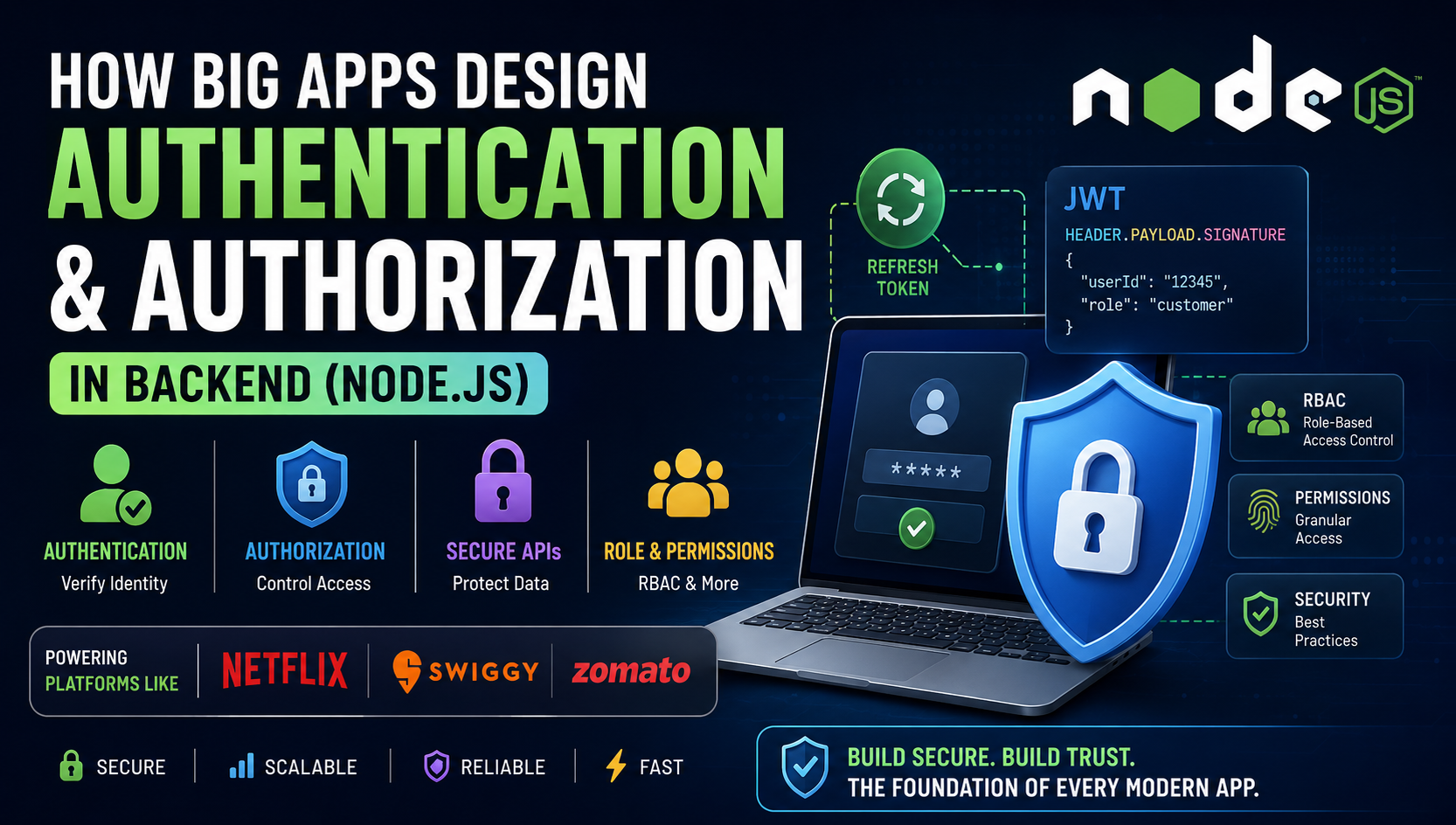
From Netflix streaming millions of videos to Swiggy and Zomato handling real-time food orders, modern applications manage enormous amounts of user activity every second. Behind these platforms lies one of the most important parts of backend engineering Authentication and Authorization.
These systems are not just about login screens. They protect user data, secure APIs, manage permissions, prevent attacks, and ensure that millions of users can safely access applications at scale.
In this blog, we’ll explore how large-scale applications design secure authentication and authorization systems using Node.js and modern backend architecture practices.
Understanding Authentication vs Authorization
Authentication verifies the identity of the user.
Examples:
- Login with email and password
- OTP verification
- Google login
Authorization determines what the authenticated user is allowed to access.
Examples:
- Admin can delete users
- Customer can place orders
- Delivery partner can update delivery status
Why Authentication Systems Matter in Large Applications
Applications like Netflix, Swiggy, and Zomato handle:
- Millions of active users
- Sensitive personal information
- Payment systems
- Real-time APIs
- Multi-device logins
A poorly designed authentication system can lead to:
- Account hacking
- Unauthorized access
- Data leaks
- Payment fraud
- API abuse
Common Authentication Methods Used by Big Apps
1. Email & Password Authentication
2. OTP Authentication
3. Social Login (OAuth)
4. JWT Authentication
5. Session Authentication
Email and Password Authentication
Flow:
1. User registers with email and password
2. Password is hashed before storing
3. During login, password is verified
4. Access token is generated
Node.js Example:
const bcrypt = require("bcrypt");
const hashedPassword = await bcrypt.hash(password, 10);
Why hashing matters:
- Prevents plain password storage
- Protects users even if DB leaks
OTP Authentication
Used heavily by:
- Swiggy
- Zomato
- Uber
Flow:
1. User enters mobile number
2. Backend generates OTP
3. OTP sent via SMS
4. User verifies OTP
5. Access token generated
Benefits:
- Faster onboarding
- Better mobile UX
- No password management
Social Authentication (OAuth)
Popular providers:
- Google
- Apple
- Facebook
Flow:
1. User clicks “Login with Google”
2. Provider authenticates user
3. Backend receives auth token
4. Application creates/verifies account
Node.js Libraries:
- Passport.js
- OAuth SDKs
JWT Authentication
JWT (JSON Web Token) is the most popular authentication mechanism in modern backend systems.
JWT Structure:
HEADER.PAYLOAD.SIGNATURE
Example Payload:
{
"userId": "12345",
"role": "customer"
}
JWT Flow:
1. User logs in
2. Backend validates credentials
3. JWT generated
4. Frontend stores token
5. Token sent with each request
Authorization Header:
Authorization: Bearer TOKEN
Node.js Example:
const jwt = require("jsonwebtoken");
const token = jwt.sign(
{ userId: user._id, role: user.role },
process.env.JWT_SECRET,
{ expiresIn: "15m" }
);
Advantages:
- Stateless authentication
- Better scaling
- Ideal for microservices
- Faster API performance
Refresh Tokens
Production applications use:
- Access Tokens
- Refresh Tokens
Why?
- Improves security
- Prevents long-lived token misuse
- Keeps users logged in securely
Flow:
1. Access token expires
2. Refresh token used
3. Backend validates refresh token
4. New access token generated
Authorization in Large Applications
Authentication identifies users.
Authorization controls permissions.
Role-Based Access Control (RBAC)
Common roles:
- Admin
- Customer
- Delivery Partner
- Restaurant Owner
Example Middleware:
const authorize = (...roles) => {
return (req, res, next) => {
if (!roles.includes(req.user.role)) {
return res.status(403).send("Forbidden");
}
next();
};
};
Permission-Based Authorization
Examples:
- CREATE_ORDER
- DELETE_USER
- VIEW_ANALYTICS
Provides granular control.
API Gateway Authentication
Flow:
Client → API Gateway → Microservices
Responsibilities:
- JWT validation
- Rate limiting
- Request routing
- Logging
- Centralized authentication
Benefits:
- Better scalability
- Improved security
- Easier maintenance
Security Practices Used by Big Companies
1. HTTPS Everywhere
2. Password Hashing
3. Rate Limiting
4. Multi-Factor Authentication
5. Secure Cookies
6. Token Expiration
7. Device Management
Node.js Security Libraries:
- bcrypt
- argon2
- express-rate-limit
- helmet
Authentication in Microservices
Large applications separate authentication into dedicated services.
Example Services:
- Auth Service
- User Service
- Payment Service
- Notification Service
Typical Flow:
1. User logs in
2. Auth Service generates JWT
3. API Gateway validates token
4. Requests forwarded to services
5. Authorization middleware checks permissions
Real-World Examples
Netflix:
- Device authentication
- Session management
- Distributed auth systems
Swiggy & Zomato:
- OTP login
- JWT authentication
- Role-based access control
Uber:
- Real-time authorization
- Device trust systems
- Geo-based permissions
Recommended Node.js Stack
| Purpose | Technology
| Backend Framework | Express.js / NestJS
| Password Hashing | bcrypt / argon2
| JWT | jsonwebtoken
| OAuth | Passport.js
| Rate Limiting | express-rate-limit
| Session Store | Redis
| Database | MongoDB / PostgreSQL
| API Gateway | NGINX / Kong
Common Mistakes Developers Make
- Storing plain passwords
- Weak JWT secrets
- No token expiration
- Missing rate limiting
- Trusting frontend authorization
- Storing sensitive JWT payloads
Conclusion: The Future of UI/UX is Human + AI
Authentication and authorization are the backbone of every secure application.
Companies like Netflix, Swiggy, and Zomato design authentication systems that are:
- Secure
- Scalable
- Reliable
- Fast
As a Node.js backend developer, understanding:
- JWT
- OAuth
- RBAC
- API Security
- Refresh Tokens
- Microservices Authentication
is essential for building production-grade applications. A strong authentication system is not just a feature it is the foundation of trust in every modern application.

Connect with our experts to discuss your ideas and discover the right solutions tailored to your business needs.
Join our newsletter
.svg)
.svg)